
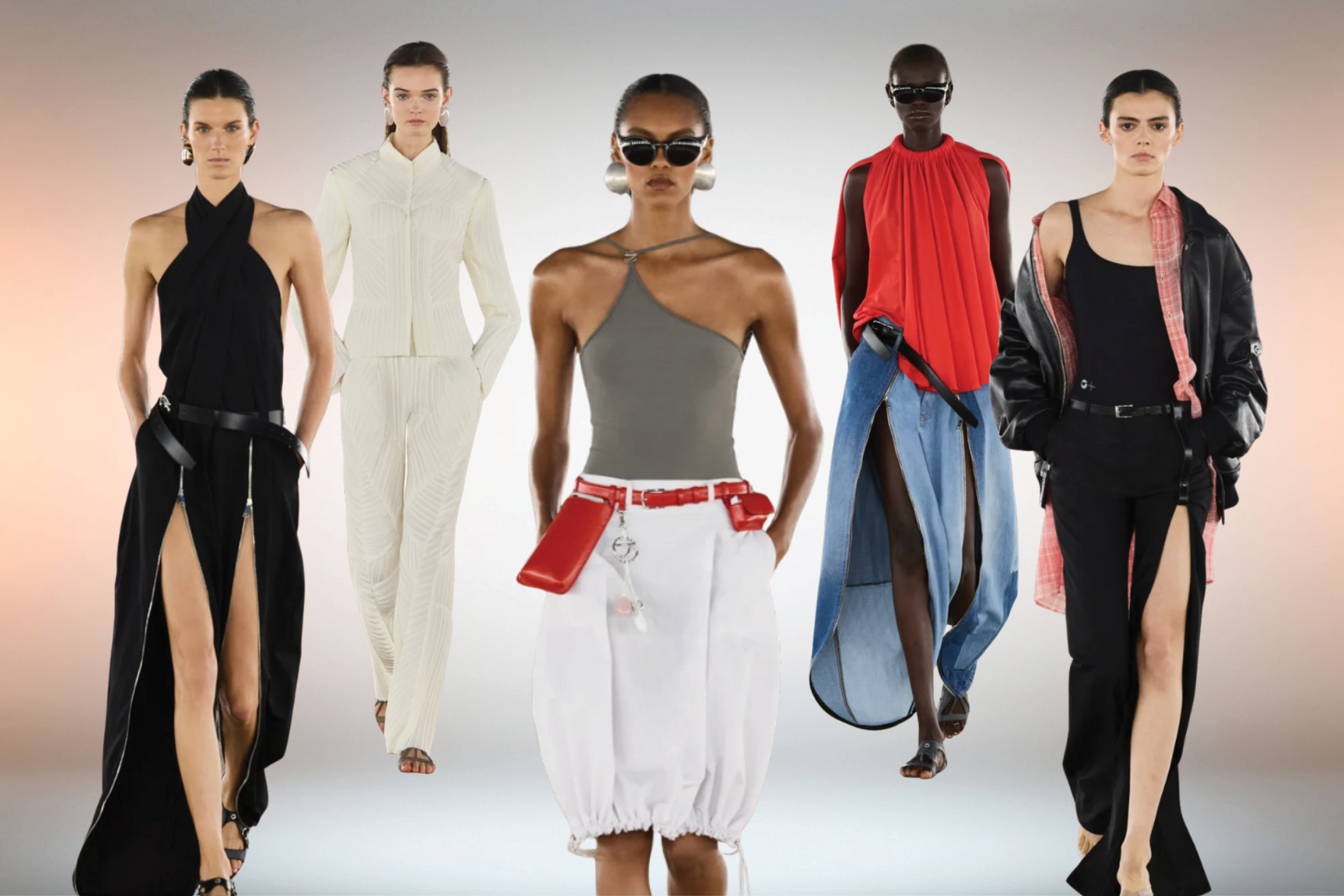
Coperni used SS26 to push its interest in technology and surface treatment, showing how fabric might act as both material and message.
The results were striking in parts, though the balance between concept and clothing was uneven.
Shapes were familiar. Slim jackets, narrow trousers and cropped skirts formed the base, while draped dresses introduced softer lines through asymmetric cuts. The silhouettes stayed within the brand’s established framework, leaving the focus on what was applied to them rather than their form.
Fabric told the story. Shiny coatings, reflective panels and high-tech finishes created impact under the lights, but often stiffened the garments. Where softer cottons, jerseys and silks were used, the clothes moved more freely and felt stronger as pieces rather than experiments. The contrast revealed both potential and limitation.
Colour centred on black, white and silver, with cobalt and yellow dropped in as accents. The palette kept the futuristic theme intact, but also contributed to a sense of coolness that risked distance. Neutral passages offered more ease, suggesting a different balance that might have added depth.
Accessories followed the clean Coperni line. Curved mini-bags, pointed shoes and slim eyewear reinforced the futuristic direction without overwhelming the looks. Styling was sharp, hair neat, and make-up touched with metallic detail to echo the surfaces of the fabrics.
The strength of the collection was its ambition. Coperni continues to test how design can incorporate technology and remain recognisable as clothing. The weakness lay in the execution: too many garments felt like tests of material rather than pieces to wear.
Seen in full, Coperni SS26 showed a label committed to pushing forward but still refining how novelty translates into daily use. Its most convincing looks were those that merged concept with comfort, proving that experiment and restraint can work together when handled with control.